

Sometimes I write about music and culture. Other times not. This is one of those other times.
This essay sits alongside three others I’ve written on AI. They share a simple view: ignoring or opposing AI doesn’t really make sense. The question is how we engage with it — and how we redesign it.
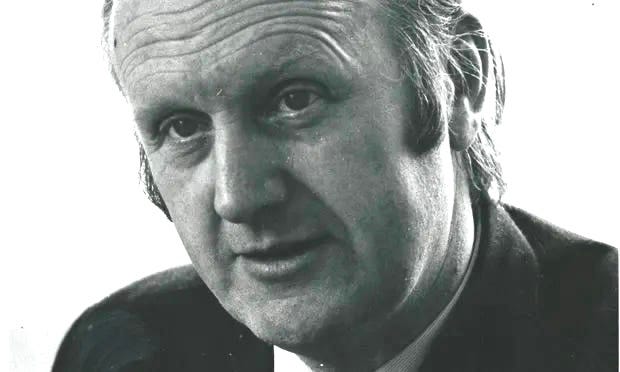
“Mike Cooley may well be the most intelligent Irishman, the most morally engaged scientist and technologist Ireland has sent abroad.”
President of Ireland, Michael D Higgins, 2018
Sometimes you read a book that opens a door that you just rush through, changing your view of the world and your place within it. Architect or Bee? by Mike Cooley was one such book — and I find myself returning to it nearly fifty years after it was written.
We are once again being told that technology will transform everything. Artificial intelligence, we are assured, will make us more productive, more creative, more efficient. It is presented as inevitable, neutral, and — above all — beyond politics.
Cooley would have recognised this story immediately.
In Architect or Bee?, Mike Cooley was writing at the moment when computers were just about to enter our everyday world. What he saw, more clearly than most, was that these were not simply new tools. They were instruments for reorganising work, redistributing skill, reshaping power — and redefining what it meant to know.
His work is rarely read today — but it should be. His ideas, and his actions, help us navigate this new world of AI.
Sadly, he died in September 2020, but this wonderfully passionate visionary designer, brilliant writer and radical trade unionist was a huge influence on the thinking of those who sought a radical human view of design and technology.
Over the years I have found myself repeatedly returning to his ideas and insights. As a student exploring society and technology, the political perspective he provided was vital. Later, as an active trade unionist, his unique approach to workplace activism became an inspiration. In my career as an academic who researched and championed craft-based learning, I was reminded of his insight that “We seem to have seriously underestimated the educational, cultural and other significance of skill and craftsmanship”.
Latterly, working in service design and committed to building the creative confidence and skills of citizens and employees, Mike Cooley’s view of ‘ordinary people’ provides a rationale: “I personally have never met an ordinary person in my life. All the people I meet are extraordinary. They’ve got all kinds of skills, abilities and talents and never are those talents used or developed or encouraged”.
It is time for his book to claim its rightful place on the reading lists of all those designing technology. The process described by Cooley concerning the transformation of engineering design in the 1970s through the introduction of CAD was echoed across other design professions. The need to pose an alternative future is vital. But let us be clear from the outset: Cooley’s argument is not anti-technology, rather it is a case concerning the inherent politics of technology. The challenge is one of understanding its politics and redesigning the technology to meet the needs of a new political agenda:
“Science and technology is not neutral, and we must at all times expose its underlying assumptions… The choices are essentially political and ideological rather than technological. As we design technological systems, we are in fact designing sets of social relationships, and as we question those social relationships and attempt to design systems differently, we are then beginning to challenge in a political way, power structures in society” (Cooley, p100).
Below I will attempt to summarise why his ideas are so vital today.
A question of control
“In the construction of its cells, a bee puts to shame many an architect. But what distinguishes the worst of architects from the best of bees is namely this: the architect constructs in his imagination that which he will ultimately erect in reality.”
Karl Marx (1974, p 174)
“Either we will have a future in which human beings are reduced to a sort of bee-like behaviour, reacting to the systems and equipment specified for them; or we will have a future in which masses of people, conscious of their skills and abilities in both a political and technical sense, decide that they are going to be architects of a new form of technological development which will enhance human creativity and mean more freedom of choice and expression rather than less.”
Mike Cooley (1980, p 100)
When many of the essays collected together in Architect or Bee were written we drove Austin Allegros, programmed computers using punch cards and rented our phones from the GPO. Much has since changed — but not the relevance of the ideas in his book.
Architect or Bee is an examination of the ‘Taylorisation’ of intellectual work. The scientific management which arose from Frederick Taylor’s time and motion studies of manual work at the turn of the century aimed to fragment labour processes into the narrow alienating tasks which later characterised mass production. The interdependent objectives this furthered were gains in productivity and management control of labour processes. The nineteenth century craft worker controlled the pace of their labour and retained the tacit craft knowledge upon which production depended. In Taylor’s system, control passed to management, and through a process of deskilling, knowledge passed into new technologies and processes of production.
Cooley regarded the computer as the Trojan Horse that was bringing Taylorisation into intellectual work such as design. He argued that CAD was sold to the engineering designers on the basis that human creativity was complimented perfectly by machine-based reliability and speed.
“However, it is not true that design methodology can be separated into two disconnected elements which can then be combined at some particular point like a chemical compound. The process by which these two dialectical opposites are united by the designer to produce a new whole is a complex, and as yet ill defined and researched area” (Cooley, p15)
The reality of CAD presented by Cooley was of design processes being increasingly fragmented and speeded up, with a consequent increase in work-related stress. The growing rate of knowledge obsolescence that the ever-changing technology of CAD systems involves together with the high pressure demands of a quickening pace of work, make workers in turn ‘obsolescent’ by the time they reach their mid-thirties. Far from presenting designers with a ‘creative tool’, CAD undermines creativity, fragments skill and leads to “a loss of the panoramic view of the design activity itself.”
If CAD fragmented the design process, AI risks abstracting it altogether. What was once distributed across people is now being captured, modelled and re-presented through systems whose inner workings are often opaque. The danger is not simply loss of skill, but the loss of connection to the act of making sense of the world.
The Lucas Plan
A depressing scenario was presented on the future of design work. But what marks Architect or Bee out from any other critique of capitalist technology is that Cooley’s ideas helped to form a radical alternative fought for by rank-and-file trade unionists. Mike Cooley was one of the architects of the Lucas Plan.

As a senior development engineer and trade unionist at Lucas Aerospace, Mike Cooley led a unique response to the increasing rate of job losses throughout the company. The Lucas Aerospace Workers’ Plan proposed new socially useful products and ‘human centred’ technologies that could be manufactured using the skills of the workforce. Energy conserving products, life support systems and new design systems were amongst a range of innovative ideas developed collectively by the trade unionists at Lucas.
Initially the workers approached nearly 200 outside organisations and academics for their ideas on what could be produced using the skills of the workforce and the facilities of the factories. Having received just three replies, Mike and his colleagues did what they said they should have done from the start — they asked the workers themselves.
150 product ideas were proposed by the workforce. This was a radical demonstration of how technology could be designed to further a politics that was about empowering creativity, meeting social needs and creating meaningful work. The Plan, of course, was never taken up by the company, but the ideas that underlay it had a huge influence.
The Financial Times described the Lucas Plan as, ‘one of the most radical alternative plans ever drawn up by workers for their company’ (Financial Times, 23 January 1976). It was nominated for the Nobel Peace Prize in 1979. According to the New Statesman ‘The philosophical and technical implications of the plan are now being discussed on average of twenty five times a week in international media’.
They gained charitable funding to set up the Centre for Alternative Industrial Systems (CAITS) at North East London Polytechnic and the Unit for the Development of Alternative Products (UDAP) at Coventry Polytechnic. Mike Cooley went on to apply these ideas in his role as a Director at the Greater London Enterprise Board, helping to set up worker co-operatives. Technology Networks were set up to combine ‘untapped skill, creativity and sheer enthusiasm’ in local communities with the ‘reservoir of scientific and innovation knowledge’ in the Polytechnics of London. A huge number of designs and prototypes were developed, “for electric bicycles, small-scale wind turbines, energy conservation services, disability devices, re-manufactured products, children’s play equipment, community computer networks, and a women’s IT co-operative. Designs were registered in an open access product bank. GLEB helped co-operatives and social enterprises develop these prototypes into businesses” (The Guardian).
The Lucas Plan was a visionary and practical proposition for a zero carbon, peaceful and socially useful economy that placed the control of design and innovation within communities.
In this short film, the former Lucas workers tell the story of their plan:
The technologies designed and championed by these workers half a century ago may have been visionary then - but they are today’s mainstream thinking. They proposed heat pumps, electric/diesel hybrid engines, solar power and wind turbines.
The lesson of the Lucas Plan is even more relevant in the age of artificial intelligence.
When workers were asked what should be designed, they did not produce marginal improvements to existing systems. They proposed entirely different futures — technologies oriented towards social need, environmental sustainability and human wellbeing. Participation did not simply improve design outcomes; it transformed the very purpose of design.
The equivalent questions today are not simply what products should be made, but what kinds of intelligence should be built: who defines the problems AI is applied to, who contributes the knowledge it learns from, and who benefits from its outputs.
A democratic approach to AI would mean opening up these questions — treating datasets, models and applications not as proprietary assets, but as sites of collective design. Just as the Lucas workers created an open access product bank, we might now imagine shared, publicly governed infrastructures of intelligence: systems shaped by collective values rather than private optimisation.
AI is not just a tool we use.
It is a system through which social relationships are redesigned.
From alchemists to architects
“It requires no violent stretch of the imagination to conceive that in the near future there will be little work other than machine making and machine minding. If the workers could secure a fair share of the advantages of labour-saving machinery its introduction might become an entire blessing” (Berg, p.195).
Technological change is the great alchemist. Where once was the tedium of work and the threat of unemployment, there is now the prospect of enriched creative employment for the few and the leisured society for the many. So argue some techno utopians. The words above were written in the 1890s when mechanisation in the engineering trades was being heralded as the great liberator. Those eventually liberated, of course, were the employers who used the new technology to reduce employment, deskill the craft dominated industry, lower wages and increase management control.
Sam Altman, CEO of OpenAI makes the same claim: “AI will probably most likely lead to a world where there is much less work that humans need to do.”
While Cooley’s ideas arose from a different political and industrial context, they remain vital in challenging the quasi-mystical claims that surround AI today. Cooley was calling for designers to become the architects of their own destiny: architects of a new profession.
The argument at the heart of Architect or Bee politicises both technology and design. Technology, he argues, is fundamentally a tool of political control in work and culture. For democracy, social progress and liberating work to be furthered, we need radically new technologies wedded to a radically new politics. Designers and technologists must play their active part in this in alliance with other progressive forces for social change. As the Lucas Plan demonstrated, designers can apply their vision and creativity to give form to the technologies of a new politics.
This applies with particular urgency to AI.
As Kate Crawford argues, AI systems are not abstract intelligence, but material infrastructures shaped by labour, data and power. Because AI systems are inherently shaped by interaction, they also create new possibilities for participation — if we choose to design them that way. People can contribute through use, through feedback, through the shaping of data, through local adaptation. But this will not happen by default. It requires deliberate design choices that position people not as passive users, but as active contributors.
If human centred design means anything in the age of AI, it must mean this: that people remain connected to the act of making meaning. That technology supports learning rather than bypassing it. That skill, judgement and interpretation are extended rather than replaced.
In this sense, Cooley’s insistence on the value of skill and craftsmanship becomes even more important. If AI is used to replace judgement, we lose skill. If it is used to extend judgement, we develop new forms of it. As the Lucas Plan demonstrated, designers can apply their vision and creativity to give form to the technologies of a new politics.
Our task today is to move beyond fragmented initiatives and towards a clearer, more politically grounded vision of design — one that includes the design of AI itself.
Humanising technology
I met Mike Cooley once, briefly while he was visiting Amsterdam, where I worked at the time, to give a public talk. A small group of us went to a bar for dinner and a couple of beers afterwards. In conversation this passion, this absolute faith in the potential of people to make their own futures made a huge impact on me.
At that time there was another vision of technology that Mike Cooley’s vision seemed to connect to. Arising from counterculture, from the idealism of techno-utopianists, was the notion that the internet (then just a glimmer on our everyday horizon) and personal computing would necessarily enhance creativity, democracy and collective world-building.
What then happened was something else. Technology was ripped from the critical and political moorings that anchor it to the needs of society. As a recent court case has established, social media was designed from the very start as an addictive drug, while AI has increasingly gone feral. As The Guardian has reported: “AI models that lie and cheat appear to be growing in number with reports of deceptive scheming surging in the last six months, a study into the technology has found… with some AI models destroying emails and other files without permission.”
But it does not have to be like this. Collectively, we have the power to do things differently. The question is not whether these systems will shape the future. It is whether we will shape them.
As Mike Cooley reminded us, our future is made, not discovered by us:
“We must not allow our common sense to be bludgeoned into silence by the determinism of science and technology, into believing that the future is already fixed. The future is not ‘out there’ in the sense that America was out there before Columbus went to discover it. It has yet got to be built by human beings and we do have real choices, but these choices will have to be fought for, and the issues are both technical and political… We have to decide whether we will fight for our right to be the architects of the future, or allow a tiny minority to reduce us to bee-like responses” (Cooley, p.77).
Further reading
Core
Cooley, M. (1980) Architect or Bee? The Human Price of Technology
Marx, K. (1976) Capital, Vol. 1
Wainwright, H. and Elliott, D. (1982) The Lucas Plan: A New Trade Unionism in the Making?
AI + labour + politics
Braverman, H. (1974) Labor and Monopoly Capital
Sennett, R. (2008) The Craftsman
Crawford, M. (2009) Shop Class as Soulcraft
AI critique
Pasquale, F. (2015) The Black Box Society
O’Neil, C. (2016) Weapons of Math Destruction
Crawford, K. (2021) Atlas of AI
Democratic / participatory design
Ehn, P. (1988) Work-Oriented Design of Computer Artifacts
Björgvinsson, E., Ehn, P., Hillgren, P. (2012) Participatory Design and ‘Democratising Innovation’
Contemporary AI + society
Acemoglu, D. & Johnson, S. (2023) Power and Progress
Varoufakis, Y. (2023) Technofeudalism
Enjoyed this a great deal Mike. Who knows where AI will take humanity, who would have predicted what Diesel’s invention would mean to future generations. AI seems trapped in the mega-billionaires net at the moment and that may well stifle any useful unintended consequences. I guess it will be a money spinner for them and bring forth some great new inventions (it should do with all the money being thrown at it) but who will benefit financially and politically? A very contrary scenario to the what happened with inventions such as WWW, polio vaccine, penicillin, car seat belt and I guess many others that were made freely available to all because they were too important for humanity.
So many great points in here. I wish that the people in power could see more strategically that skills are indeed transferrable and that they can create better infrastructures. And technologies can help us to do that. It's always about money though isn't it Mike? A great series of posts I've really enjoyed these.