

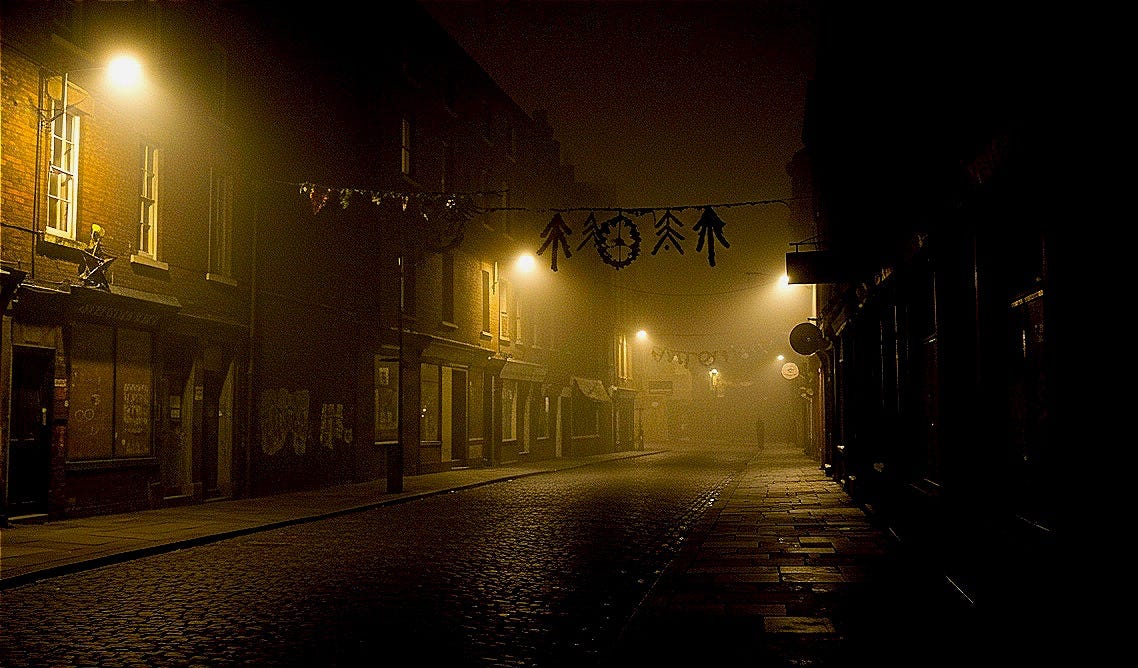
Liverpool, Christmas Eve, 1960
The Jacaranda Club was a basement den of smoke, sweat, and sound—a place where Liverpool’s young rebels and dreamers gathered, drawn by music, coffee and conversation. Tonight was the added attraction of escaping the relentless cheer of Christmas Eve. The club was dimly lit, with flickering candle stubs on wobbly tables casting ghostly shadows over walls on which were brightly painted murals. A dusty string of Christmas lights hung above the entrance, casting a dull glow of red and green across the smoky haze.
On the ground floor, where a watch repairer’s workshop once ticked away the hours, was a modest snack bar serving tea and sandwiches. But the real heartbeat of the Jacaranda pulsed below. Down in the basement—an old coal cellar transformed into a members-only coffee bar and music venue—folk stayed long past closing time. Being a private club allowed the Jac to keep its doors open until the small hours. Despite being unlicensed for alcohol, the Jac could pull in a crowd if the music was good. And tonight the music could not have been better.
Allan and Beryl, the husband-and-wife duo behind the Jacaranda, were the beating heart of the place. Allan—a short, stocky Welshman, almost always wearing his black top hat—moved with surprising agility, spinning and stomping to the rhythm as if possessed by the music. Beside him, Beryl’s wide grin and effortless sway radiated a genuine warmth. Allan had arranged for The Beatles’ raucous Hamburg residency, they had returned from only days earlier, and tonight he and Beryl were just as caught up in the music as their audience.
Allan twirling his hat in time with the music was the first thing Peggy noticed as she walked in. A Teddy Girl—or Judie as they were called—she studied at the art school. Stylish, sharp tailored, razored sides with a teddy quiff. Her dark, kohl-lined eyes hinted at a steely determination, balanced by an infectious laugh, a sharp wit, and a passion for rebellion.
Behind the narrow bar to the left, Vince was manning the counter, sliding frothy coffees across the formica with uncharacteristic ease. Usually, Vince was a gruff fixture of the Jac, known for his terse one-word replies and a scowl. But tonight, something was different. His sharp edges seemed dulled, his movements almost buoyant. When Peggy leaned in to order, Vince greeted her with an unsettlingly bright grin.
“Alright, Peggy? What’s got you out tonight then?” Vince asked, his voice strangely soft.
Peggy blinked. In all the months she’d been coming to the Jac, Vince had barely acknowledged her, let alone started a conversation. She frowned, wary. “Same as always, Vince. You won the pools or summat?”
“Nah, love.” Vince chuckled, his words slower now, as if savoring them. “Just feels like there’s honey in me veins.”
Peggy shifted on her feet, uneasy. There was something off in Vince’s voice, a syrupy lilt that didn’t belong. His eyes, too—a flicker of something strange that made Peggy’s stomach twist. She shook her head and muttered, “Right, then,” as if brushing it off. But she couldn’t quite ignore the prickle at the back of her neck.
On stage, The Beatles were in the midst of their raw, loud, captivating glory. A Christmas Eve show for their hardcore fans. They’d clearly learned a trick or two in Hamburg. John leaned into the mic, his eyes flashing with something dangerous, while Paul’s fingers moved across his guitar with practised ease, a grin tugging at his lips. John's voice tore through the chaos, rough and biting, making the lyrics sound like they’d been ripped from his heart. George hammered out razor-sharp riffs on his guitar, as off to the side Stuart behind his trademark shades anchored their sound with his bassline. And at the back, Pete—steady as a heartbeat—pounding out a backbeat that kept the crowd clapping, stomping, and shouting for more.
Tonight, they were on fire. Both ends burning. The pulse of rock and roll throbbed through the walls of the club, its beat seeping into the city’s ancient bones, echoing down narrow alleyways and forgotten corners. But not all echoes faded into silence. Some slipped through hidden cracks, snaking down into the darkness of the Williamson Tunnels beneath the city—into places no human eye had seen in years. The sound was a lure, a vibration that stirred the stagnant air in long-abandoned passageways, rousing something that had slumbered there, waiting.
The tunnels - a network of arched brick passages, vaults and chambers - were built in the early 19th century by Joseph Williamson, an eccentric and wealthy tobacco merchant, for reasons that nobody could fathom. But Peggy was up for having a go.
Curiosity not only drove her art, but drew her to whispered tales of the old tunnels. Some said they led to hidden treasures; others hinted at stranger, darker things. Peggy didn’t know what she believed, but she had a knack for finding her way into places she shouldn’t be. Tonight was going to be no different.
She leaned against the bar as the band took a quick break between numbers, just enough time to quench their thirst and light a cigarette.
“Hey, Johnny,” Peggy called, leaning in close. “What do you reckon’s down there in them tunnels? Could be something mad, eh? Something no one’s ever seen before?”
John Lennon gave her a long, sideways look, one eyebrow arched, lips curled in a lazy half-smile as he took a drag from his Stuyvesant. “You’ve got a head full o’ nonsense, Peggy. If it’s a choice between Shangri-fucking-la and a river of turds barrelling down to the Mersey, then my vote’s for shite central any day. Beats me why you’re so obsessed with it.”
Peggy grinned, undeterred. “Come on, there’s got to be more to it. Could be tunnels to all sorts of places, hidden doors, lost bits of history… you never think about that, la?”
John shrugged, flicking ash onto the floor. “Only thing I’m thinkin’ about right now is getting through the next set without cockin’ it up. You wanna go down there, be my guest. But if you come back stinking of shite, don’t expect us to save you a spot at the bar.”
“Oi, Johnny! On stage!” George called from across the room, gesturing impatiently.
“Duty calls,” John said, clapping Peggy on the shoulder. “Listen, if you find the Holy Grail down there, you can buy us all a round, yeah?”
“Yeah, yeah.” Peggy watched as John and the others went back to the stage, the crowd’s roar rising as the band kicked back into their set. For a moment, she hesitated, the throb of curiosity almost drowned out by the music. But tonight the allure of the tunnels was too strong.
Through a conversation she’d overheard at a nearby pub, she’d learned that beneath the cast iron storm drain cover in the alley next to the Jacaranda was a ladder leading down—not just to the storm drains, but to the tunnels themselves.
Vince leaned across the bar, that strange glint back in his eye. “I know what you’re thinking, Peggy. Go on. You know you want to.”
She made for the door.
As she reached for the handle, a hand touched her shoulder, heavy and firm. She turned to see Mal, the gentle giant who often came to the Jac after his shifts at the telephone exchange. The man’s broad shoulders seemed to fill the space. But there was something else in Mal’s face tonight—something uneasy.
“Peggy, love” Mal said softly, his deep voice cutting through the muffled thrum of the club. His hand lingered on her shoulder. “I’ve heard about those tunnels. They’re not just dangerous—they’re wrong.”
Normally, Mal was the sort to smile and let people be. For a moment, Peggy glanced back at the stage. The band was tuning up for their next set, John cracking a joke into the mic that made the crowd howl with laughter. It would be so easy to stay.
“Come on,” Mal urged. “The boys are giving us all they’ve got tonight.”
Peggy hesitated. Mal had a point. They’d not even got onto their Chuck Berry songs yet. Peggyy liked Mal. A kind man, she thought. Considerate, caring and sensible. But maybe too sensible.
“Nah, you’re alright Mal,” she said. “But thanks all the same.” And with that she was gone.
Outside in the alley, the night air was sharp and cold, prickling Peggy’s skin. A few flakes of snow drifted down from the black sky. The streets were deserted. She found the drain cover and prised it open, the iron grate scraping against the pavement. With a final glance back at the club, she began her descent, the music fading as she climbed down.
The air grew damp and thick, pressing in around her like a living thing. She could still faintly hear the pulsing beat of music from above, but down here, it felt warped, distorted—a slow, throbbing sound that seemed to sync with her own heartbeat. She flicked her Zippo, its trembling flame casting faint, uncertain light across the walls, which were slick with moss and streaked with dark, ominous stains.
The smell grew stronger with every step—a sharp tang of metal and the earthy rot of things long dead. The walls closed in, slick with moss and streaked with dark stains that gleamed faintly in the dim light of her Zippo. Her footsteps echoed, too loud, as though the tunnels were amplifying every sound she made.
She turned one corner, then another, stepping further into Liverpool’s underground labyrinth. Ahead of her two passages led off from each side of the main tunnel. She took the left, and stepped carefully over some dark puddles, as the passage took a sharp turn ahead of her. The air felt colder in the still quiet of the tunnel, her eyes straining to make out what lay ahead as the lighter’s flame flickered.
Then she heard it—a faint, wet scraping, like something heavy dragging against stone. Peggy froze, the flame of the Zippo trembling in her hand. She strained to see beyond the circle of light, but the shadows seemed to thicken, shifting with a life of their own.
“Hello?” she whispered, barely louder than a breath.
The darkness swallowed her words. For a moment, the silence pressed in, thick and suffocating. Then it came—a low, rasping exhale that prickled the hairs on the back of her neck. The sound wasn’t human. It was ancient. Hungry.
She turned around and began to retrace her steps with a quickening pace. She heard it again behind her, this time louder. Panic surged, cold and sharp.
The main tunnel was ahead, but it seemed somehow different. She couldn’t remember which way to turn. In fact she couldn’t remember why she was there. All she was conscious of was her heart pounding and the icy clutch of fear.
She took a step back, then another, her hand scrabbling at the damp stone for balance. She tried to turn, to run, but her legs felt heavy, as if the tunnel itself were holding her in place. Try as she might, her limbs could barely move. Her throat tightened, but she couldn’t scream—her voice trapped in her chest, strangled by the choking weight of the dark.
Her grip on the Zippo slipped. The lighter dropped, the tiny flame sputtering out as it hit the ground, plunging her into total blackness.
The breath grew louder, shifting, sliding, as though whatever made it was circling her, closing in from all sides. The darkness pressed against her skin, dense and cold, seeping into her mouth, her nose, filling her lungs with a reeking stench of decay.
Something brushed against her arm—a touch colder than death. She tried to pull back, but it clung to her, winding around her wrist, her ankle, pulling her deeper. Her strength ebbed, her limbs going slack, as if the very life were being drained from her.
She felt something wrapping around her legs, squeezing. She tried to scream, but the air wouldn’t come. Cold tendrils snaked up her arms. Her chest burned. Move. MOVE. But her legs felt like stone. Something pierced her skin. Agony shot through her. Hot. Cold. All at once. She felt something coursing through her body, writhing and filling her, a sickly, honey-thick warmth sliding into her veins. Then she felt nothing.
Above, the music in the Jac faltered—a single missed beat, like a heart skipping. But then it surged on.
Paul was doing his Little Richard number, sweat flying off his head as he shook it in time to the pulsing beat, the crowd totally absorbed in the spectacle of sweat and sound. None of them noticed the door open and a figure step inside. But Vince did, smiling as Peggy approached the counter, her eyes sparkling. He watched as Peggy leaned in, the light casting a sickly sheen over her too-pale face.
“Feels like there’s honey in my veins,” Peggy murmured, her voice low and strange, almost a purr.
Vince slid a Coke across the counter. “Aye… reckon it does. Right sweet, that.”
Peggy raised the bottle to her lips, her hand trembling slightly. Vince watched, unsettled, but he couldn’t look away. As she drank, her face began to change—a deathly pallor spread across her skin, and her lips pulled back, revealing teeth tinged with something dark and viscous, like oil.
Around the club, people were starting to notice, their laughter and chatter fading into uneasy murmurs. The air felt colder, heavier, as if something was pushing down on them all.
Then Peggy’s mouth opened in a silent scream, her eyes rolling back as her body convulsed, limbs jerking in spasms. A shadow seemed to pool around her feet, a sickly darkness leaking from her mouth, her eyes, spreading like spilled ink. Vince stumbled backward as the shadow rose, coiling up Peggy’s body like smoke—dense, thick, almost solid. It began to form a shape: twisted limbs, eyes that glistened with an ancient, unnatural hunger.
The shadow creature took a step forward, its gaze sweeping across the terrified crowd. But before it could advance further, a voice cut through the silence.
"Back off, pal. We’re trying to put on a show here.”
John Lennon stood on the edge of the stage, guitar in hand, his face set in a defiant scowl. The shadow creature hissed, its form wavering as if testing the air, tasting the threat in their stance.
Peggy, her voice weak and strangled, rasped, “Run, lads… just… run…”
But John only tightened his grip on the neck of his Rickenbacker, stepping forward. “Nah, Peggy love. We’re right where we’re supposed to be.”
The crowd, too stunned to react, watched as Paul adjusted his guitar, an almost defiant grin stretching across his face. George closed his eyes for a moment, then locked eyes with the creature, his gaze steely and unflinching. Pete Best, drumsticks held tightly, tapped out a rhythm on his leg, his face pale but determined. And Stu? Well Stu generally played with his back to the audience anyway, so he only had half an idea of what was going on.
“Let’s give this fucker the best gig of its life,” John said, strumming his guitar, the first heavy, dissonant chord slicing through the tense air.
The others joined in, each note vibrating with raw, electric energy. It wasn’t like their usual sound - it was darker, a pulsing rhythm that echoed through the club and seemed to shake the walls. It filled the space, a low, throbbing beat that clashed with the creature’s hissing, forcing it to recoil, its shadowy form flickering.
The crowd felt it too, something electric and ancient, as if the sound was calling to something deep within them. People began to sway in time to the beat, their fear replaced by a strange, trance-like calm. Even Vince found himself gripping the counter, a glint of hope in his eyes.
The creature shrieked, an ear-splitting wail that rattled the glass bottles behind the bar, but John just turned up the amp, his fingers dancing over the strings. “Come on, you right nasty bugger,” he muttered, half to himself. “You want to take this city? You’ve got to go through us first.”
Paul leaned into the mic, his voice booming with an eerie power as he launched into an improvised chant, each word pounding like a heartbeat. “We’ve got rhythm, we’ve got soul, we’ve got the power of rock and roll.”
The crowd echoed him, their voices rising, filling the room with something fierce and primal. Together, the musicians built a wall of sound, their instruments merging into something huge, protective, unstoppable. Then together they hit one final, blistering chord—a powerful, dissonant clash that shook the room.
The creature convulsed, its body twisting, pieces of it dissolving like smoke. With a final, agonised wail, it collapsed inward, sucked back into the darkness below. The room fell silent, leaving only the sour scent of decay hanging in the air.
Paul turned to George “Fucking hell George, what was that chord? It was ace.”
“Dunno exactly… but I reckon in all eventuality it was an F added ninth with a G on top and whatever you were doing underneath. We should use it in a song.”
Paul hurried to the bar, helping Peggy to her feet.
“Hey Judie, you alright, love?”
“Yeah. Ta, la.” She smiled at him, and he gave her a wink before replacing the black top hat onto the head of its owner and returning to the stage.
The crowd let out a collective breath, their eyes wide. John’s gaze swept over the audience, a smirk playing on his lips, mischief flickering in his eyes.
“For our next song,” he drawled, “those of you who didn’t faint, clap your hands. The rest of you—try to keep your fucking teeth from chattering.”
The room rippled with laughter, and Paul chimed in: “I think it’s time for this one I wrote with our kid George. It’s called In Spite of All the Danger.”
He paused, casting a glance at his bandmates, his smile warm but charged with anticipation. Then, with an easy nod, he began the count-in.
“One, two, three, four…”
O2 Arena, London, 19 December 2024
Paul McCartney raised his Hofner bass high above his head, a triumphant grin lighting up his face as the final chord reverberated through the arena. The crowd roared a wall of sound.
In the middle of it all stood Peggy, clapping until her palms stung, with tears rolling down her cheeks. Her granddaughter, Ellie, beside her, beamed with pride and threw an arm around her shoulders, pulling her into a hug.
“You’re crying!”
“Course I am, love,” she said, wiping her face. “It was magic. Pure, pure magic.”
As the lights began to come up, Peggy stayed rooted in place for just a moment longer, staring at the stage. Ellie tugged gently on her arm. “Come on, let’s go.”
She nodded, letting Ellie take her by the hand and guide her down the steps. She could usually manage with her Parkinson’s fine, but steps always needed a bit of extra care. They joined the tide of people streaming toward the exits, the buzz of conversation swirling around them. Ellie glanced at her. “I suppose there’s no point in asking if you enjoyed it,” she said, grinning.
Peggy chuckled softly. “It was something else, Ellie. A real treat. Thanks, love.”
“So, has he changed much?”
“Nah. Same Paul. Same grin. Same magic in his fingers. A bit more grey on top.” She laughed, but there was a wistfulness in her voice, a faraway look in her eye.
Ellie pressed on. “So, was this the first time you’ve seen him since, what, 1960?”
Peggy hesitated as they stepped out into the cold London night, her breath visible in the frosty air. “Yeah. First time.”
“And you never saw them again? Not after that Christmas Eve gig?”
“No. They went back to Hamburg. And I left for London to start my design course. Life’s funny that way.”
“Still…” Ellie gave her a curious look. “It must’ve been incredible. You were there right at the start, weren’t you? I bet it felt like you were watching history being made.”
Peggy stopped walking for a moment, the noise of the bustling crowd fading into the background. Her hand tightened on Ellie’s. “Oh, it was incredible, alright. It was at a ballroom over the river in Wallasey. Nobody else could touch them. They had something—something raw, like they were summoning the world’s energy. But…” She paused, her voice dropping.
“But what?” Ellie asked, tilting her head.
Peggy shook her head, trying to shake off the memory. “Nothing. Just an old woman’s mad thoughts.”
Ellie raised an eyebrow. “You’re not getting off that easily!”
She sighed, her breath fogging in the cold. “After that night… after that gig, I had this dream. A real nightmare, it was. They were in it, but back in the Jac… tunnels… a monster… I’ve never had one like it before or since. It felt so real.”
The cold bit harder as they turned toward the tube station. A busker was playing Yesterday on an acoustic guitar by the entrance, his voice warm against the icy night.
“So,” Ellie said, pulling her scarf tighter, “shall we take the Underground?”
Peggy looked at the tall glass front of North Greenwich station, and behind it the escalators that led down to the network of tunnels that snaked under the city. Ruffling her fingers through her full grey quiff, she turned with a gentle smile to her granddaughter.
“Underground? No, I don’t think so, love. Let’s take the bus.”
She took Ellie’s hand, her grip firm and steady as they headed down the street, leaving the station behind. The faint sound of the busker’s guitar followed them, its melody lingering in the air like a ghost of the past.
Did you enjoy this story?
Peggy, in our story, is one of 150,000 people in Britain living with Parkinson’s. There's currently no cure for Parkinson's - but there are lots of ways for people to manage their symptoms and continue to live well in daily life with the condition. New treatments are within our reach, with your support. Can you help fund pioneering research projects? Please go here and make a donation. Thank you very much.
https://www.parkinsons.org.uk/get-involved/support-research-breakthroughs
Some notes
“In Spite of All the Danger,” written by Paul McCartney and George Harrison, was the first song recorded by The Quarrymen—a group consisting of John Lennon, Paul McCartney, George Harrison, pianist John Lowe, and drummer Colin Hanton—in the summer of 1958. The song featured on the setlist for Paul McCartney’s 2024 world tour.
Allan Williams was The Beatles’ first manager, and owner of the Jacaranda Club. The group’s final appearance at the Jac was on 14 August 1960, just before leaving for their first residency in Hamburg.
By early December, most of the band had returned to Liverpool from Hamburg, but bassist Stuart Sutcliffe remained in Germany. For their December gigs, Chas Newby temporarily filled in on bass. On Christmas Eve 1960, the group performed at the Grosvenor Ballroom in Liscard, Wallasey.
Thousands of hours—and at least one PhD—have been dedicated to identifying the most famous chord in rock music history: the iconic opening chord of “A Hard Day’s Night,” recorded by The Beatles in 1964. In an online chat in February 2001, George Harrison described it as: “It is F with a G on top (on the 12-string), but you’ll have to ask Paul about the bass note to get the proper story.”
Music theorist Walter Everett, who has researched this chord extensively, suggests that Harrison and producer George Martin play F A C G on twelve-string guitar and piano, while Paul McCartney plays a D on bass. Yet, despite the research, this remains only a theory, and the chord has taken on a near-mystical status in music history.
And Mal Evans - later the group’s roadie and personal assistant - was a regular at the Cavern, not the Jacaranda. But who knows? He may have visited it once or twice.
While we’ve bent history slightly—also introducing the fictional characters Peggy, Vince and Ellie—it’s all in the spirit of capturing the moment.
If you’re inspired to explore more of Liverpool’s rich history, guided tours of the Williamson Tunnels can be booked in advance at: www.williamsontunnels.co.uk.
Finally, the Judies, or Teddy Girls, of whom Peggy was one, were photographed by the young Ken Russell in the 1950s. Here is one of his remarkable photographs.

And for those of you using Apple Music, here’s The Beatles live from 1958-1963.
Wishing a Merry Christmas to all.
Really enjoyed that, thanks!
Oh, you have no idea how happy I am to see a Beatles fic on substack (being a devoted reader on A03, but most of those probably couldn't be on substack... )! More please!!!!
(I was thinking it was an AU where the Christmas Eve show moved to the Jac, so well done on pivoting at the last minute back to Grosvenor.)
Also, the line about Stu not knowing what the hell was going on made me laugh out loud.
PS You probably know the manhole cover on Mathew Street has a history all of its own, related to Bill Drummond.
Well done.