
Twist and Shout
How Fiona Adams captured a different Britain on a London bomb site

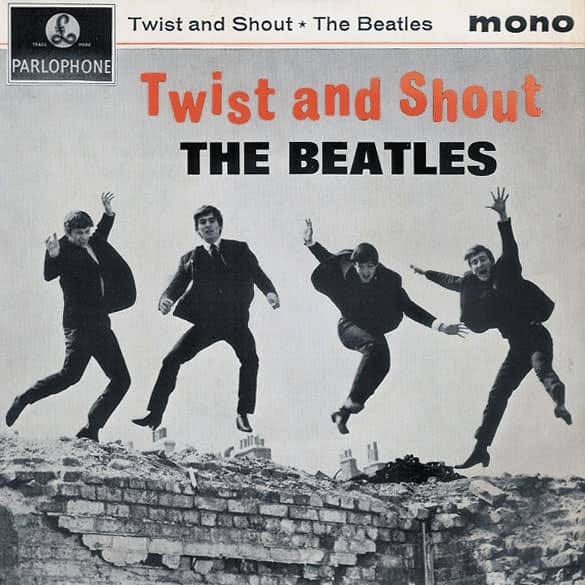
This was the first record I was ever given. The cover fascinated and inspired me almost as much as the music.
Over the years, I’ve come to see that sleeve as one of the most significant images in twentieth-century popular music. It communicates an extraordinary amount about who The Beatles were, about British culture, and about a country in the midst of profound change. In those terms, it is more revealing and ultimately more important than the artwork for Sgt. Pepper.
More recently, I’ve realised that the cover also tells a story about a side of Soho’s creative ecosystem that is rarely taken seriously: the pop-magazine world aimed at teenage girls, and the women who worked within it. So let us look closely at this remarkable image, and then at the story of how it came into being.
What we see
The Twist & Shout cover is monochrome. Four young men in identical dark suits are caught mid-jump, arms flung outward, frozen in playful, almost chaotic poses. They appear to be leaping over a rough, broken brick wall. Their expressions are animated rather than posed: smiles, open mouths, limbs splayed. They are exuberant.
The typography is bold and simple. Twist and Shout appears in striking red, apart from a faint line at the top it is the only strong colour on the sleeve. The Parlophone logo and the word mono sit calmly above.
On a purely descriptive level, this is not a glamorous image. There is no studio polish, no sense of luxury or aspiration. It is raw, kinetic and informal.
Energy, disorder and youth
Your eye is drawn to the jumping bodies. They do most (but not all) of the symbolic heavy lifting in this image. Jumping signifies motion, release and the refusal of stillness. This is in stark contrast to the highly polished studio portraits that dominated popular music imagery of this era. This photograph communicates spontaneity and physical freedom. The band are not so much posed as caught.
This sense of being caught - captured - rather than arranged, suggests authenticity. These are not distant stars. They are living bodies, mid-movement, barely contained by the frame. These people have minds of their own, they express themselves the way they choose. As individuals.
And what are they wearing? Dark suits, shirts and ties. Their suits nod toward respectability, but their behaviour disrupts it. And then, cast your eye down. The boots. As a seven year old, it was John Lennon’s right foot that grabbed most of my attention. That heel, the elegant curve of the upper. I’d not seen anything like that in Freeman, Hardy & Willis. The tension between smart clothing and unruly movement produced a powerful message: we belong to your world, but we will not behave according to your rules.
There’s an unrestrained physicality on display, but it’s clearly playful rather than aggressive. As a seven year old, the way the image redefined a sense of masculinity worked subconsciously on me, but now it’s far clearer. This is not the emotionally constrained buttoned-up masculinity associated with Britain at that time. Neither is it threatening or particularly sexually charged. Instead, it is expressive, emotional and just a bit over the top.
And there’s something else that is different. Something that’s challenging - at least it was to all the record companies that had turned them down. No single figure dominates the frame. The four bodies are visually equal. Yes, they’re individuals, each jumping in their own way, but we’re seeing a collective, not a hierarchy. British working-class values of friendship and mutuality are on display here - a musical pals battalion. A contrast to the American hero-focused pop imagery. The band is the star.
The wall: post-war Britain as backdrop
As a child in 1963, I played on bomb sites, especially where my grandparents lived in Bristol. Bombed out ruins were still a familiar sight in Britain’s industrial cities. Reconstruction was taking place, but in some areas it remained very slow. So the crumbling brick wall carried particular symbolic weight at the time.
As we’ll discover in a short while, this was a real bombed out site. There was no darkroom trickery involved in the photograph. Or trampolines. The Beatles were jumping above a fifteen foot drop on a bombed out ruin. Health and safety gone mad.
Symbolically, the wall can be read as a reminder of wartime destruction that we had experienced less than two decades earlier. We can also interpret it as a symbol of old social and generational structures, and perhaps as a boundary to be crossed.
The Beatles are not shown rebuilding the wall. They are dancing on it.
The image maker: Fiona Adams
This photograph was taken by Fiona Adams. She was a young, Guernsey-born photographer, freelancing at the time for the teen pop magazine Boyfriend. Running as a weekly from 1959 to 1965, it was fan-focused and image-led. It published pin-ups, personality features, competitions and fashion. Its job was not to analyse music, rather to make the personas of pop stars more accessible to fans.
Magazines like Boyfriend were, and still are, rarely treated as culturally serious. They are poorly archived. Their writers and photographers are seldom remembered. This is not accidental. They represent the female side of youth culture, and historically that has been dismissed as trivial, disposable or hysterical.
Yet Boyfriend was part of the machinery that enabled the youth of the early 1960s to create their own culture, and made Beatlemania possible. It mediated between record companies and fans. It shaped how young people felt about music, not just how they consumed it.
21 Kingly Street today is a Sri Lankan restaurant. But in the early 1960s Boyfriend’s offices were on one of the building’s upper floors. It was a Thursday. 18th April 1963. In the evening The Beatles would be topping the bill at the Royal Albert Hall, after which Paul McCartney would meet Jane Asher for the first time. In many respects, it was a big day for the group.
The Beatles had met Fiona Adams the previous Sunday when they were filming their slot for Thank Your Lucky Stars at Teddington TV studio. She had asked them to come to the office for a photoshoot for the magazine.
They started at Boyfriend’s cramped photo studio, then she had the idea to take them out. As she later said:
“I had been keen at that time to break away from the conventional Hollywood-style of stage and studio shot. To this end, I would ride around on the top deck of London buses to search out possible locations. An abandoned area had caught my eye at the crossroads of Euston and Gower Street. This was still a London blitzed in parts and awaiting rebuilding.”
So, The Beatles, Fiona and her camera gear, and journalist Maureen O’Grady all piled into a taxi to the location that the photographer had found. She climbed down into the bombed out cellar, open to the sky, while The Beatles stood on the wall above her and leapt at her command. Three rolls of film later, and they were done.
The photographs were not commissioned for a record sleeve, but for a feature in Boyfriend, but when John Lennon and their publicist Tony Barrow went through the contacts to approve the one for publication, this shot stood out.
Capturing a different Britain
Used for the EP cover, Fiona Adams was uncredited: standard practice at the time. She continued her career photographing musicians before marrying in 1972, returning to the Channel Islands and carrying on her work there. She died in Guernsey in 2020. Her name never became mythic in the way her subjects’ did. But at a crucial moment, she captured something that was to become transformative.
Adams belonged to a Soho that is less celebrated and less remembered. Not the Soho of clubs, recording studios and boutiques, but the Soho of desks, telephones, contact sheets and filing cabinets. It was in those back rooms, and in bombed-out London spaces just beyond them, that pop culture was sifted, selected and styled before it reached the world.
Boyfriend stood alongside the music papers of its era, different in tone, different in audience, but equally vital within the creative ecosystem that shaped how a generation understood itself. The emotional language of pop did not flow only through the NME or Melody Maker; it flowed through teenage girls’ magazines as well.
And this single image captures that shift. It is not an image of escape from Britain. The setting is unmistakably local, ordinary, post-war. The message is not we are leaving this behind, but we are changing how we live within it. A generation is not running away from the ruins; it is dancing on them.
In that movement - joyful, collective, unembarrassed - lies the beginning of a different Britain.
Notes
Our quote from Fiona Adams comes from here: https://www.beatlesbible.com/1963/04/25/beatles-photographed-by-fiona-adams/
This was a piece that draws on a range of online sources, and checking dates with the books that we’ve detailed in our previous bibliography.
A couple of inspirations and thanks here…
The Picture This series by Margaret Bennett is one of my Substack highlights and so I borrowed her semiotic approach and overall sense of joy when describing photos.
Another highlight is Wendy Varley whose Wendy’s World often explores her time as a journalist for Just Seventeen on Carnaby Street. She knows far more about this side of publishing than I ever will, and her posts are always fascinating.
How fascinating that the brilliant cover photo on Twist and Shout came from a photo shoot for Boyfriend magazine. What an image!
Thanks so much for the kind mention, Mike. Teenage magazines had real reach and influence for several decades. Such a big part of youth culture.
It was fun to read this. I never knew anything about that image but it’s been familiar to me for a long time. I can imagine the scene very clearly now, thank you.
I’ve never heard of Fiona. A great shot.
Thanks also for the mention Mike, it’s most appreciated.