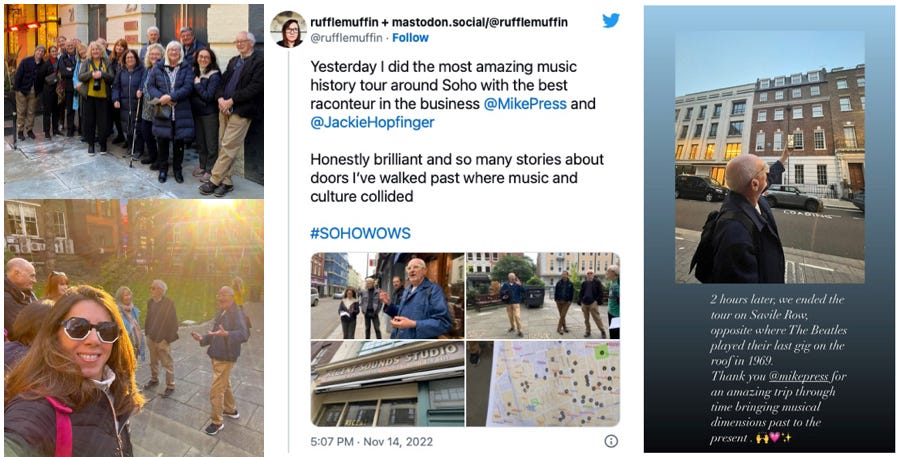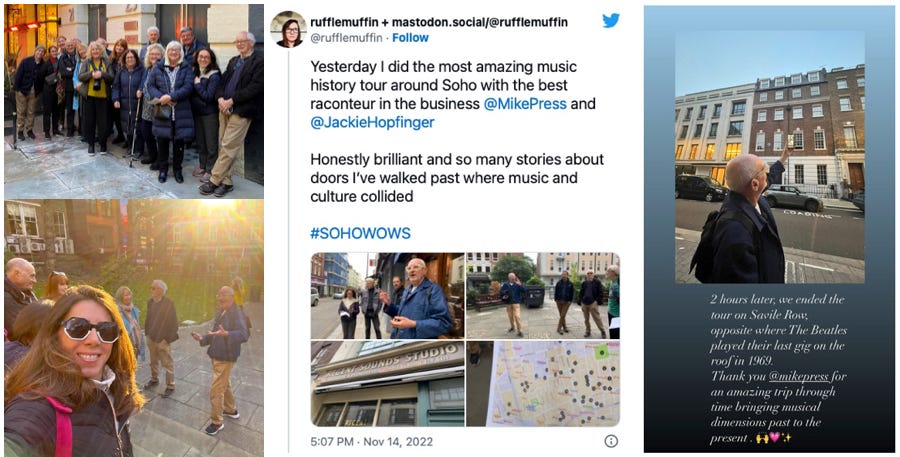
We’ve been doing these walks since 2022. The idea at the start was to share the research we have been doing on the history of music in Soho that form the basis of many of our Substack posts. Organising one every four months or so was our aim, given that one of us lives in Edinburgh. The first few walks were gradual refinements of the same broad theme - how Soho offered opportunities for people to make music and create cultures.
As our research developed, alongside the experience of doing the walks, so we realised that they offered us opportunities to explore specific themes. We began with our our Greatest Hits and Deeper Cuts walks, then developed into music and politics, before pulling in new themes from the worlds of medicine, science, innovation and economics for how Soho invented the modern world. We’ve even done a couple of Christmas specials.
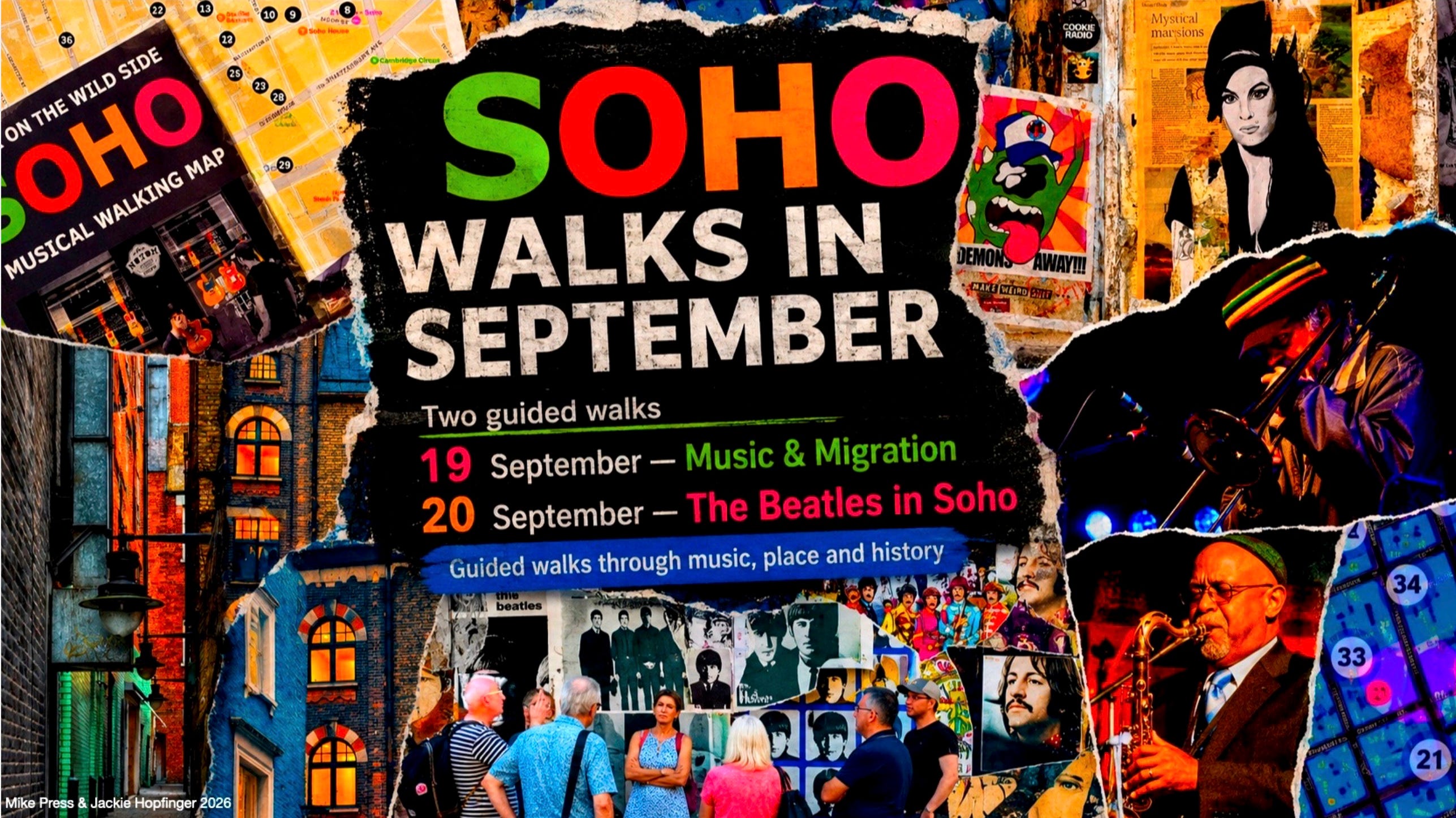
On one weekend this September we’re doing two walks. Music and migration is a new theme for us and will look at how migrants and refugees have found musical homes in Soho, and in the process made a vital contribution to our country’s popular music. The Beatles in Soho will be the second outing for this walk, since we first did it six months ago.
Music and migration
The first professional musicians to perform in London came from somewhere in the Roman Empire around 2,000 years ago. That’s how long migrants have been making music here. As for Soho specifically, its musical roots again go back to Italians in the mid 18th century, around the time that Charles Ignatius Sancho, who was born into slavery and was the first Black Briton to have his music performed. Jewish refugees brought their music with them from central and eastern music, when they settled in Soho in the 19th century, which evolved into Yiddisher Jazz.
On our two hour guided walk, we’ll explore how migration shaped the music of one of the most significant square miles in world music history. In Soho’s clubs jazz, R&B, and the blues fed into homegrown skiffle and rock and roll, while London’s growing Afro-Caribbean communities fused ska and reggae into Lovers Rock. Even Afrobeat’s origins can be found in a club on Wardour Street. Greek Cypriots were behind the emergence of British folk-rock, and some of the most defining music of the 1980s.
You’ll discover how Soho became a place to live and work for migrants, refugees and other marginalised communities, and how music gave voice to identity, resistance, joy and belonging. People arriving on boats didn’t just give us defining parts of our culture like fish and chips - but they helped to create the soundtracks for our lives.
The Beatles in Soho
Liverpool gave them roots, their values, their passions. Hamburg sharpened their craft and saw them evolve into a coherent group. But it was in London - and Soho in particular - that The Beatles learned how the music industry and modern Britain really worked. London was where their identity came sharply into focus. And it was in London where they became the focus of a revolution in how creativity, class and power collided at a moment of rapid social and cultural change.
Ours isn’t a walking tour about fame or nostalgia. It’s a walk that looks at what The Beatles learned, and how those lessons shaped their music, their ambitions, and the foundations of the modern music industry. In the 1960s, Soho wasn’t just a backdrop to success. It was a system. Within a few narrow streets sat the publishers who controlled songs, the studios that reshaped sound, the tailors who reworked style and class, the editors who constructed images, the broadcasters who turned local acts into national forces, and the filmmakers who learned how to project popular music across the world.
We will take you on a walk through that system, taking a look at some iconic locations along the way - the studio where Hey Jude was recorded and ending by looking up at the roof where they last performed.
Join us!
Music and Migration is on Saturday 19 September, starting at 2.00 pm for around two hours. Click here for details.
The Beatles in Soho is on Sunday 20 September starting at 2.00 pm for around two hours. Click here for details.
Both walks are free to join, but after the walk we invite participants to donate what they feel the walk is worth directly to Centrepoint, the charity supporting young homeless people. Donation details will be shared on the day.
The walks will give you:
A deeper understanding of how creativity, community and power interact
A sense of why Soho mattered at turning points in Britain’s social and cultural history
A specially curated Spotify playlist in advance
A colour map of Soho showing it as a landscape of change
The chance to support Centrepoint, helping homeless young people
Convivial chats, a bit of light exercise and a drink afterwards